Adrian Orr
Reserve Bank of New Zealand
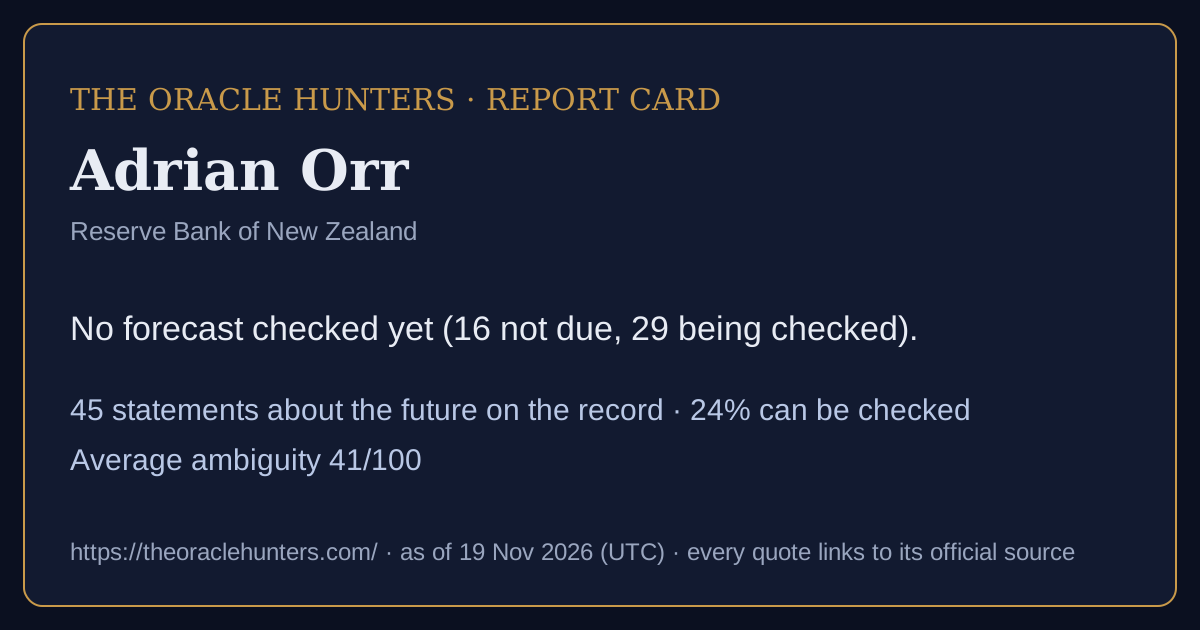
Track record: No forecast checked yet (16 not due, 29 being checked).
45forecasts & commitments on the record
24%can be checked as stated
41average ambiguity (0-100)
0goalpost moves recorded
0confirmed U-turns
Timeline
came true partly did not not due / being checked / too vague
Calibration score: shown after 10 checked forecasts with a stated likelihood (now 0).
How they speak about the future: based on data 29, stated on authority 10, educated guess 6.
Kinds of claim: forecast 31, mixed claim 8, scenario (if… then) 4, commitment 2. · Download this report card as a picture
In the nine words
πρόγνωσιςInference from evidence27 · 60%μαντείαInspired knowledge9 · 20%πρόνοιαPreparing for the future4 · 9%εἰκασίαConjecture3 · 7%προαναγγελίαPublic pre-announcement2 · 4%
How to read this
Each box is one sentence a public figure or institution said about the future, word for word, with a link to the official text. Can be checked means it names what will happen, by when, and how likely - so it can be compared with official figures later. Too vague to check means it does not. Ambiguity (0-100) is how many different ways the sentence can be read. When the date passes, the forecast is compared with official data and marked came true, partly or did not come true. Labels judge the sentence, never the person. Full guide and glossary.On the record (45)
Note: The shaded area represents the MPC's 1 to 3 percent target range for annual CPI inflation over the medium term.
Note: The dashed lines represent the MPC's 1 to 3 percent target range for inflation over the medium term.
Our findings will be public later this year and should have flow on impacts for Māori access to capital.
We are now reporting on our own carbon footprint, and we will be sharing our emissions targets and planning early in 2023.
To provide the best context possible for the Committee's decision I will refer briefly to the Reserve Bank's recently published Review of our monetary policy actions over the five years endedSeptember 2022. 1
Our Monetary Policy Remit 3 defines the Monetary Policy Committee's objectives: to focus on keeping inflation between 1% and 3% over the medium term and supporting maximum sustainable employment.
Over the next two years this will feature four workstreams and two taskforces on climate risk, climate scenarios, and monetary policy.
As you may be aware, the External Reporting Board's (XRB) final consultation for the proposed draft standards on climate related disclosures closes next week, and the standards will be published in time for the start of mandatory disclosure next year.
This year's exercises will build our own and industry capability and inform our climate scenario stress test next year.
In May this year, the Bank of England (BoE) published the results of its inaugural scenario analysis.
The International Energy Agency estimates that such action will require US$ 3.5 trillion per annum until 2050 for energy sector investments alone 13 .
We are legally expected to deliver our advice no later than November 2023.
We have now raised the OCR by a further 25 basis points, signalled we will sell down our LSAP holdings over the coming years, and steepened our OCR outlook further.
To be explicit, the Committee ceased quantitative easing in July 2021 by ending the purchase of Government Bonds, and over the remainder of 2021 we raised the OCR by 25 basis points twice, and signalled it will return to more 'neutral' levels by late 2022.
More details on how bond holdings will be reduced will be provided early next year.
We have also seen consumer price inflation rise and expect it to move temporarily above 5 percent in the near term.
The Reserve Bank of New Zealand Act 2021 has now passed into law and will come into force in July 2022.
Capital requirements for banks will progressively increase from 1 July 2022 and it is encouraging to see them rising ahead of our timeline.
The final report will be released in 2022.
These changes will support our transformation as we implement the new Reserve Bank of New Zealand Act due for Royal Assent later this year. 6
Our latest Statement of Intent , released today, sets out our strategic priorities for the next three years and outlines how we will continue our role as kaitiaki of New Zealand's financial ecosystem. 3 4 5
The drivers of residential property investment can then be explained by factors influencing expected risk and return such as, for example, the ability to leverage (a 20% deposit on a house implies 5:1 leverage), tax (dis)advantages of competing investments, and/or myopic investment behaviours leading to under- over-investment.
An early taste of this will occur in early 2021, when the seasonal influx of international tourists fails to show up at our doorstep.
Even if economic activity picks up over 2021, unemployment will remain
These lags could become longer if higher debt eventually raised the likelihood of deleveraging to repair balance sheets and restore net worth (see right chart slide 9).
Between March and May alone, euro area banks extended €245 billion of credit to firms (see left chart slide 5).
The net purchase phase of the programme will run until at least June 2021 and, in any case, for as long as the crisis persists.
Our measures have complemented and reinforced the strong fiscal expansion in the euro area that paved the way for a recovery in economic activity in the third quarter of this year, which was significantly faster than widely expected (see left chart slide 6).
In the coming weeks, the Governing Council will assess how our toolkit should be adjusted to best support the economy during the course of next year and beyond, based on the medium-term inflation outlook.
If sustained, these conditions could lend themselves to persistently low inflation and higher unemployment.
We could also introduce term lending activities if the above combined actions proved insufficient and if retail banks are not passing on the very low rates to customers.
The Reserve Bank could consider changes to the cash system to mitigate cash hoarding if lower deposit rates led to significant hoarding. |
It could also involve the MPC announcing a commitment to keep monetary policy expansionary, in order to hit our monetary policy targets in the medium term, even if the MPC expect this to eventually push inflation above 2% or employment above its sustainable level. |
We will also continue to engage with banks and other deposit takers on their risk-assurance processes and, if necessary, work with banks to strengthen these controls and commitments.
When we talk about unconventional monetary policy and fighting slowdowns, it is of course important to take a step back and look through the gloom: we are not in a recession, and we expect the economy to recover over 2020.
The public report of this review is expected to be published in the first quarter of 2020.
The themes and issues that were identified in our 2017 discussion paper 3 will be considered further in 2020.
Our review of the Insurance Act will commence in earnest in 2020.
However, over the next year or so we expect to consult with the industry on a range of changes that will look to strengthen each pillar.
The process started last year and will run through until the middle of next year, when legislation is due to be introduced to the House.
We are committed to meeting the currency needs of the people, ensuring low and stable inflation, maximising sustainable employment, and promoting a sound and efficient financial system.
Some will even comment publicly, 'How dare the Governor speak outside of their 1 to 3 percent inflation mandate!'
As well as working on the internal models approaches, we are also well underway with proposals for the implementation of the standardised approaches and will be enter into discussions with the industry on these also over this year and next.
Regulatory capital requirements for banks incorporated in New Zealand will be calculated under Basel II from January 2008.
Banks applying to be "accredited" to use internal models to calculate minimum capital requirements will need to submit their applications to the Reserve Bank by July this year.
Also said - not checkable as stated (12 newest)
Remarks about the future with no date, figure or likelihood that could be checked. They are kept on the record and shown here, but not scored.
The sooner this happens, the sooner we will be able to truly claim to have put the inflationary pressure of the COVID-19 period behind us.
This is likely to reflect -among other things -that following a period of high (or low) inflation, some prices may need to adjust by more (or less) to restore relative prices to equilibrium.
When we experience a shock, it doesn't change the goal, the island doesn't move, it just changes how we will get there (figure 4).
Some outcomes are so bad that we must steer forcefully away from them if they become probable.
At Te Pūtea Matua we will continue to highlight the importance of collaboration, and the need to focus on solutions to improve Māori access to capital.
We are also working with the Ministry of Business, Innovation and Employment to get an updated Māori economy report , which, with the help of BERL, is coming out next year.
Te P ū tea Matua has the mandate to help address M ā ori access to capital, but we will not succeed alone.
As part of our recent Financial Inclusion Thematic Review, we spoke with a significant number of deposit-taking entities to understand their internal policies and practices on inclusion, and how they measure and report progress. 15 Lessons from this work will guide us on what banking data infrastructure and indicators are useful.
This should disappoint all New Zealanders, in part given that the Māori economy remains one of the largest potential sources of economic growth.
The Monetary Policy Committee will be giving its full assessment of the latest economic data at our February Monetary Policy Statement, due out at the end of this month.
The new Deposit Takers Act, as mentioned by our Chair, will strengthen and simplify our approach to the regulation of banks and other deposit takers, and introduce the Depositor Compensation Scheme.
The cash system will need to adapt over time to continue to meet the needs of New Zealanders, potentially including a new digital New Zealand dollar, to circulate alongside physical cash.