Admiral Sir Tony Radakin
Ministry of Defence · GBR
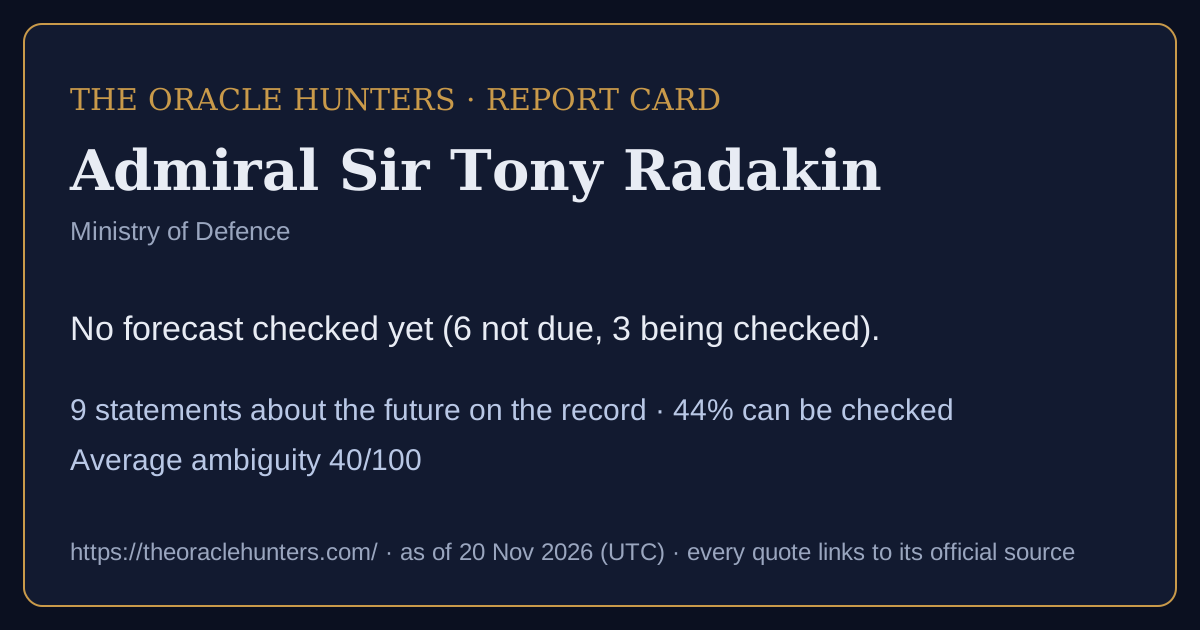
Track record: No forecast checked yet (6 not due, 3 being checked).
9forecasts & commitments on the record
44%can be checked as stated
40average ambiguity (0-100)
0goalpost moves recorded
0confirmed U-turns
Timeline
came true partly did not not due / being checked / too vague
Calibration score: shown after 10 checked forecasts with a stated likelihood (now 0).
How they speak about the future: based on data 8, stated on authority 1.
Kinds of claim: forecast 6, mixed claim 2, commitment 1. · Download this report card as a picture
In the nine words
πρόγνωσιςInference from evidence7 · 78%προαναγγελίαPublic pre-announcement1 · 11%μαντείαInspired knowledge1 · 11%
How to read this
Each box is one sentence a public figure or institution said about the future, word for word, with a link to the official text. Can be checked means it names what will happen, by when, and how likely - so it can be compared with official figures later. Too vague to check means it does not. Ambiguity (0-100) is how many different ways the sentence can be read. When the date passes, the forecast is compared with official data and marked came true, partly or did not come true. Labels judge the sentence, never the person. Full guide and glossary.On the record (9)
The Strategic Defence Review currently underway will assess the capabilities required against the resource available which, as the government has repeatedly stated, will rise to 2.5%.
In the United Kingdom, on the back of an improving economic outlook, the Government has chosen to invest 2.5% of our national wealth in Defence.
We are now adjusting to an Army that will be at the heart of NATO as one of SACEUR’s two Strategic Reserves, and is the beneficiary of £41 billion of new investment.
More than the £38 billion in capital we will spend on the non-nuclear parts of the Navy or the £36 billion we will spend on Air.
With 80% of the deployable force now aligned to NATO, 16,000 troops deploying to Europe next year.
And he cannot order a general mobilisation - at least not ahead of next year’s election - for fear of how his own people will respond.
This, backed by that central will to fight, explains why Ukraine – a modest military power by any calculation – has recaptured already over 50% of the territory it lost.
And by 2023 we will have established a second Response Group permanently based in the Indian Ocean.
And crucially, along with additional and more modern ships, we will have increased availability, to the extent that the Fleet Commander’s deployable destroyer and frigate days double between 2020 and 2030.
Also said - not checkable as stated (12 newest)
Remarks about the future with no date, figure or likelihood that could be checked. They are kept on the record and shown here, but not scored.
And we deter by demonstrating to Russia that we are stronger, that we are ready to fight, and that we will beat them.
People like Gundbert Scherf of Helsing are right to challenge us as to whether we need to be pooling our efforts through a Manhattan Project type endeavour, and through the architecture of international security that followed.
Thank you to Lord Mandelson and the British Defence Staff, and to the Centre for Strategic and International Studies for hosting what is probably my last public speech as Chief of the Defence Staff.
That is now changing and we are on a path of greater investment – but it will take time for the effects to be felt in terms of new capabilities, improved readiness and better support to achieve the ambition of the Government’s Strategic Defence Review to return our Armed Forces to a much more substantial level of warfighting readiness.
And Russia has had to shift its economy to a war effort, which it will be incredibly hard to row back from.
We have the financial, military and intellectual might to buttress and defend the world order and confront those who undermine it.
And Jim Hockenhull wants Strategic Command to make the decisive leap to better use the data we have to prosecute 10x and 100x the number of targets we may need to strike.
And the possibility of tens of thousands more to follow as part of a new security pact with Russia, which could involve the exchange of the most sensitive technology and expertise between Moscow and Pyongyang.
Where we have got it right is because we used an entirely different set of permissions which elevated speed and embraced risk so that we could help Ukraine.
Safe to fail may require Defence to think and act much more like an investor.
And for the UK, as well as placing ourselves ‘NATO First’, in which areas might we be ‘First in NATO’?
And that’s how we will keep our nation safe.