Admiral Sir Philip Jones
Ministry of Defence · GBR
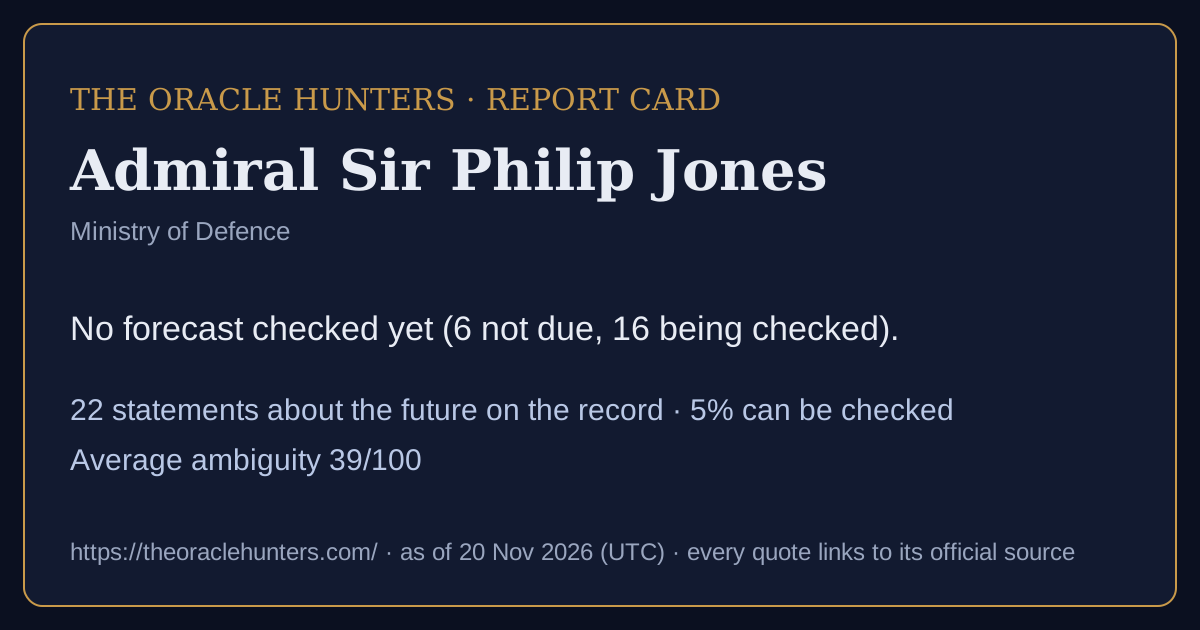
Track record: No forecast checked yet (6 not due, 16 being checked).
22forecasts & commitments on the record
5%can be checked as stated
39average ambiguity (0-100)
0goalpost moves recorded
0confirmed U-turns
Timeline
came true partly did not not due / being checked / too vague
Calibration score: shown after 10 checked forecasts with a stated likelihood (now 0).
How they speak about the future: based on data 14, stated on authority 8.
Kinds of claim: forecast 18, mixed claim 3, commitment 1. · Download this report card as a picture
In the nine words
πρόγνωσιςInference from evidence14 · 64%μαντείαInspired knowledge7 · 32%προαναγγελίαPublic pre-announcement1 · 5%
How to read this
Each box is one sentence a public figure or institution said about the future, word for word, with a link to the official text. Can be checked means it names what will happen, by when, and how likely - so it can be compared with official figures later. Too vague to check means it does not. Ambiguity (0-100) is how many different ways the sentence can be read. When the date passes, the forecast is compared with official data and marked came true, partly or did not come true. Labels judge the sentence, never the person. Full guide and glossary.On the record (22)
Now you could understand the First Sea Lord releasing a strategy like that, or at least a policy directorate within the Ministry of Defence, but as many of you will know it’s actually a Department for Transport strategy, released in January this year following wide cross government stakeholder input.
Increasingly our intentions are going to be built around forward deployed presence, as the Royal Navy looks to different operating models and different manning models within our transformation agenda, building from the Modernising Defence Programme of earlier this year.
So maybe instead of trying to predict the incidence and form of future conflicts, maybe it’s better instead to consider the context of the maritime environment in 2035, a context that will provide the setting in which future naval warfare may be conducted.
In 2035 there is little doubt in my mind that the security and prosperity of this island nation will still rest upon our access to, and our freedom of manoeuvre on, the global commons that is the sea.
As I highlighted earlier, the platforms that we are building now will be pretty much ones we will be operating in 2035.
By setting out our stall now, by clearly demonstrating our resolve to defend our interests and uphold the international rules based system, we will set the conditions for the future, and that’s a future that we can, if we are canny, hold right the way out to 2035.
By 2045 it’s estimated that Asia will account for 75% of global consumers and this shift in the customer base to that region will only serve to increase our reliance on seaborne trade.
They were at the forefront of our disaster relief efforts in the Caribbean in September; and next year they will head to the Gulf and to India with the Joint Expeditionary Force for large scale exercises.
So, in future, hackathons and agile sprints will become regular events, and we are programming a regular series of Information Warrior exercises between now and 2021.
To that end, later this year HMS Westminster will go to sea fitted with an open architecture shared infrastructure which enable the rapid integration and development of new capabilities.
If successful, we will roll this system out to the rest of the Type 23s by 2020, and the remainder of the fleet thereafter.
The Secretary of State has called 2017 the ‘Year of the Navy’ but, in truth, the opportunities will continue through 2018 and beyond: this is nothing less than a new era of British maritime power.
US Marine Corps F35B joint strike fighters will join those from the UK for HMS Queen Elizabeth’s first deployment in 2021, but after that it’s down to us.
As the Prime Minister announced last month, HMS Argyll will visit the Asia-Pacific region in 2018 for exercises under the Five Powers Defence Arrangements and with other partners.
In the longer term, NATO will remain the cornerstone of our defence.
Before the end of the year she will hoist the White Ensign for the first time, and her sister ship will be officially named in Rosyth.
2017 will truly be the ‘Year of the Carrier’, as HMS Queen Elizabeth leaves her builders, commences sea trials and arrives in Portsmouth for the first time.
By 2023 up to 24 will be available to fly from the carriers.
On the skyline in Portsmouth, meanwhile, the iconic silhouette of HMS Victory will next year be joined by that of a 65,000 tonne aircraft carrier.
Later this year, technology companies from around the world will demonstrate their unmanned and autonomous systems through Exercise Unmanned Warrior off the coast of Scotland.
We acknowledge the fact that when the French carrier Charles De Gaulle enters refit, as she does next year, it will leave Europe without a large aircraft carrier available for contingent operations.
Crucially, last year’s defence review included a commitment to greater numbers of F35B jets earlier than originally planned, so that up to 24 will be available to embark on our carriers by 2023.
Also said - not checkable as stated (12 newest)
Remarks about the future with no date, figure or likelihood that could be checked. They are kept on the record and shown here, but not scored.
And I think we can anticipate Russia employing a combination of conventional and non conventional methods to carry on exerting its influence in the North Atlantic – and we have to be ready for that.
Put simply, in the years to come, Russian effort to exploit sea power in and around our own back yard here in the UK is likely to be a constant – and something we will not be able to ignore.
And this constant requirement to improve productivity so that we make best use of scarce public resource – something that has been driving trade offs between efficiency and resilience, between capability and mass, between affordability and lethality, for a long time, will continue to need to be addressed.
I could not echo the Secretary of State’s words more; we have to sustain this forward through successive spending reviews and Strategic defence and Security Reviews – and that’s the message from Sir John Parker’s National Shipbuilding Strategy too.
But if we’re going to be credible in that leadership role, we need to also lead thinking within Defence, across Government, with our allies and out into the wider maritime enterprise – to make sure we can correctly design the maritime force for tomorrow and correctly recruit and retain the people to man it.
The important thing in all of this is that by developing these capabilities in tandem, we instinctively build in a level of interoperability that might not otherwise be there.
As most of you know, because of his 2 jobs I have to share Admiral Lanba with my CDS, General Carter, so the formal CDS bit of the programme is tomorrow here in London, and I’m very much looking forward to hosting him as Naval Chiefs down in Portsmouth for the 2 days that follow that.
Nor should we forget that the Indian Ocean that’s more than a transit corridor; its densely populated littoral zones are areas of significant, rapid, economic growth in their own right, growth that is underpinned in part by the rich natural resources that are found in the huge expanse of water that is the Indian Ocean.
But at the same time, to again paraphrase my Defence Secretary, we will not shy away from telling them when we feel that they do not respect the commonly accepted rules and norms of international behaviour, the laws and systems from which we all benefit and therefore have a duty to protect.
Specifically, in the Maritime domain, we are committed to ensure that the global commons remain secure and freely available for all mariners who are going about their lawful purpose, anywhere in the world, and we will continue to work to ensure that the laws and conventions that exist to protect those rights are followed.
As I said at my Sea Power conference at RUSI a few weeks before that IISS event I did with CNO, we were feeding off the UK Defence Concepts and Doctrine Centre’s analysis of Global Strategic Trends which clearly identifies the economic shift towards the Indo-Pacific region; that’s already on the way and will only intensify in the years to …
When you combine this with the well established importance and growth of global maritime trade, and the UK’s ambitions for an enhanced global trade network once we depart from the European Union, it becomes very easy to see why the Indo-Pacific region will be of such strategic importance to this island nation in the years to come – physically separated …