Admiral Sir Mark Stanhope
Ministry of Defence · GBR
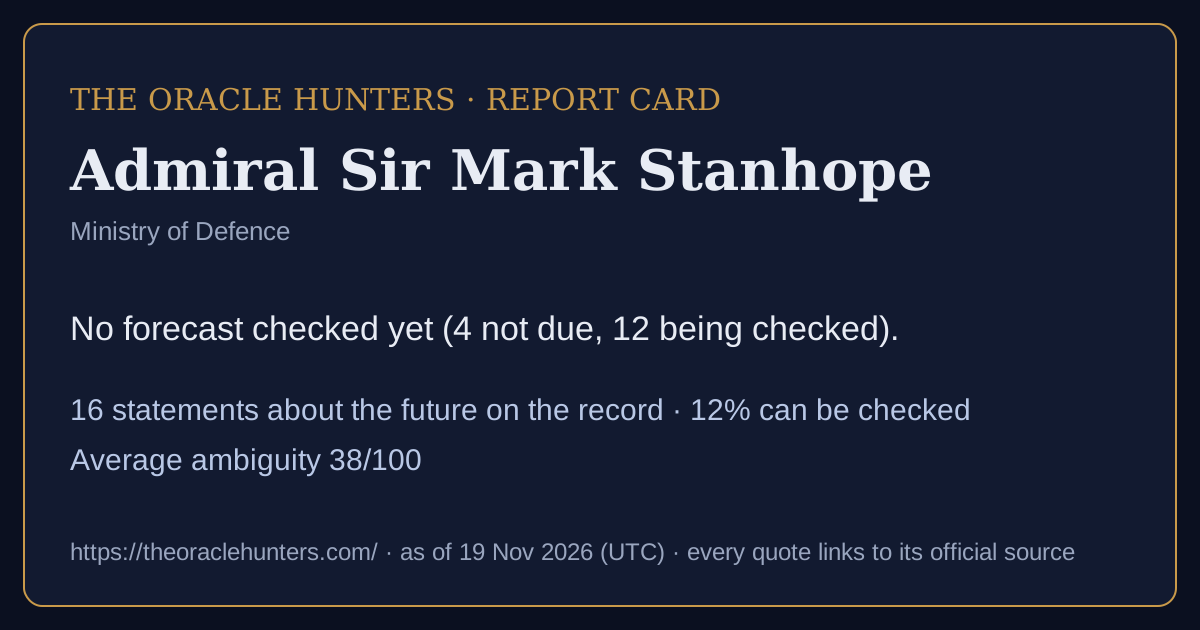
Track record: No forecast checked yet (4 not due, 12 being checked).
16forecasts & commitments on the record
12%can be checked as stated
38average ambiguity (0-100)
0goalpost moves recorded
0confirmed U-turns
Timeline
came true partly did not not due / being checked / too vague
Calibration score: shown after 10 checked forecasts with a stated likelihood (now 0).
How they speak about the future: based on data 14, stated on authority 2.
Kinds of claim: mixed claim 8, forecast 8. · Download this report card as a picture
In the nine words
How to read this
Each box is one sentence a public figure or institution said about the future, word for word, with a link to the official text. Can be checked means it names what will happen, by when, and how likely - so it can be compared with official figures later. Too vague to check means it does not. Ambiguity (0-100) is how many different ways the sentence can be read. When the date passes, the forecast is compared with official data and marked came true, partly or did not come true. Labels judge the sentence, never the person. Full guide and glossary.On the record (16)
In closing I reflect on nearly 4 years as First Sea Lord and take heart that……amongst the perennial debates over the balance between ambition and resource, between long and short term imperatives, and between current operations versus future requirements……there are many compelling truths that serve the Royal Navy well and which this year’s Battle of the Atlantic 70th anniversary will …
And next month, the white ensign will be flying from all 6 type 45 destroyers……3 of which have, on operational deployments across 3 oceans, already surpassed expectations in many areas.
First of class flying trials for rotary wing will commence towards the end of 2017.
Already crewing up in Rosyth, the Queen Elizabeth aircraft carrier will next year be brought out of dock in order to commence sea trials in 2016 and to allow assembly of the Prince of Wales to begin.
This year we will record the 44th year of unbroken continuous at sea deterrence.
By 2016 all maritime helicopters will have either been replaced or upgraded……and in the same year we will receive the first of fleet tankers on a 6 monthly drumbeat.
Equally, if the melting of Arctic Ice continues as predicted by some, the chart of global maritime trade could, by 2030, be almost entirely re-drawn.
Indeed, by 2020, the military trained strength will have shrunk by almost a fifth……and the civilian workforce by twice that.
The first is the investment in carrier strike……which will give the UK the capability and readiness that a value for money defence must provide……especially when the cost of operating our carriers is marginal (just 1%) to the cost of building them.
And it would appear that previous forecasts of regular transit of the north west passage by 2030, just 6 years from now, will indeed come to pass.
So……fast forward, if you will, to say 2024 please……12 years hence.
……I hope that we will leave our successors in 2024 a legacy……of which they can be pleased……and of which we can be proud.
and if 2012 predictions are still correct, then next year, in 2025, China will constitute around 30% of the world’s GDP
Indeed, through next year and beyond, the Flagship project of longer term UK military involvement in Afghanistan will be our support to the development of the Afghan National Army Officers’ Academy in Kabul.
And as we move towards 2015 the focus will shift almost exclusively onto a train, Advise and Assist role to the Afghan National Security Forces.
But in an emerging maritime era, which would witness an increase in the demand for maritime power, we will need to ask ourselves, not just “what can our navy do for our country?” but “what can our navy do for our collective defence?”.
Also said - not checkable as stated (12 newest)
Remarks about the future with no date, figure or likelihood that could be checked. They are kept on the record and shown here, but not scored.
But I think that the military can, and should, be part of a more nuanced first resort……to better understand the security situation so that we can improve our ability to anticipate tension……as well as to do something to contain it before it becomes a crisis.
Equally, our response to austerity also requires us to adjust our approach to how, in the future, we will fight……as we move from, as the Secretary of State for Defence puts it, “campaigns to contingency”.
That is not to say that we shall be any less safe……but the security environment will certainly be less predictable.
Whilst inevitably, our world of 2024 has changed in ways which were unforeseen……some of the forecasts appear to have, for good or bad, come to pass:
And since then, our “economisation of international security affairs” has indeed had a strong maritime dimension, playing out as it has in those ‘pivotal regions’……as it will continue to do I suspect in the years ahead.
Of course we need to be able to respond to the ‘most likely’, but we must also be able to respond to the ‘most dangerous’.
With its return, our ability to influence events ashore, whether by promoting stability, deterring aggression, or providing options for military intervention, will become correspondingly much more effective.
Air power from the sea was an important part of our national story last century, and it will continue to be a vital part of our national story this century.
But while defence is about preventing wars, we can only do so if we can win them, and that means we must retain the capability to operate, nationally and multinationally, right across the ‘spectrum of uncertainty’.
But I think that the military can, and should, be part of a more nuanced first resort, to better understand the security situation so that we can improve our ability to anticipate tension, as well as to do something to contain it.
For understanding our future environment is the first step to establishing how, particularly in these straitened times, we might wish to shape it and how we might have to engage with it.
Events over which we shall have little direct control.