Abdul Rasheed Ghaffour
Central bank (via BIS)
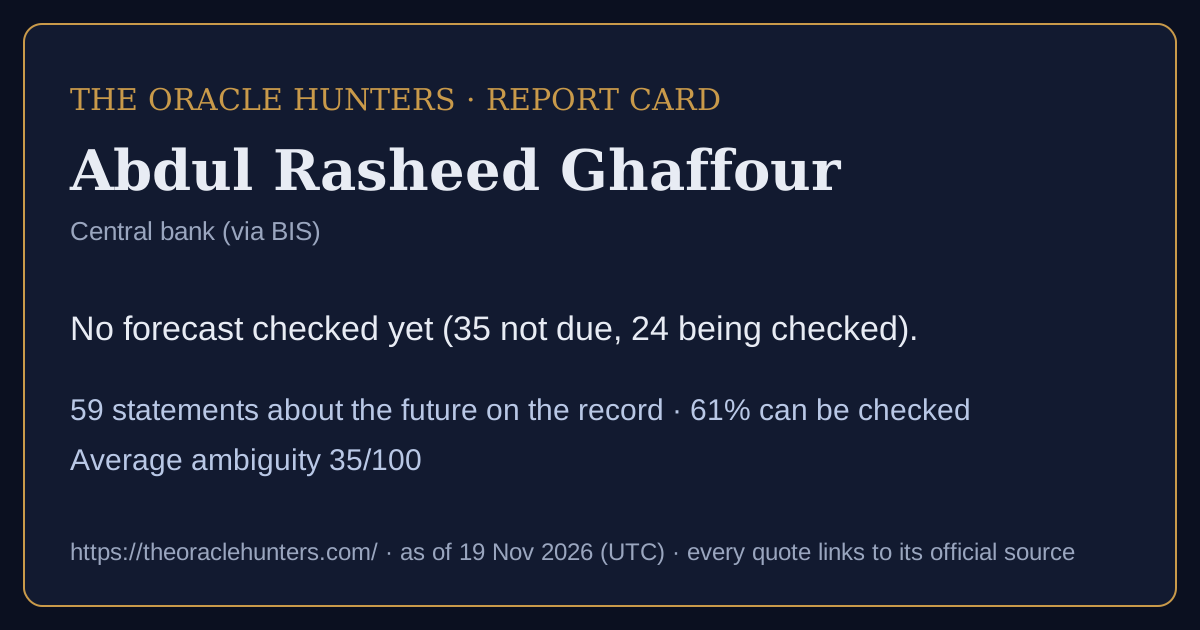
Track record: No forecast checked yet (35 not due, 24 being checked).
59forecasts & commitments on the record
61%can be checked as stated
35average ambiguity (0-100)
0goalpost moves recorded
0confirmed U-turns
Timeline
came true partly did not not due / being checked / too vague
Calibration score: shown after 10 checked forecasts with a stated likelihood (now 0).
How they speak about the future: based on data 47, stated on authority 10, educated guess 2.
Kinds of claim: forecast 49, mixed claim 5, commitment 3, scenario (if… then) 2. · Download this report card as a picture
In the nine words
πρόγνωσιςInference from evidence45 · 76%μαντείαInspired knowledge7 · 12%προαναγγελίαPublic pre-announcement3 · 5%πρόνοιαPreparing for the future2 · 3%εἰκασίαConjecture1 · 2%πρόβλεψιςSeeing the signs1 · 2%
How to read this
Each box is one sentence a public figure or institution said about the future, word for word, with a link to the official text. Can be checked means it names what will happen, by when, and how likely - so it can be compared with official figures later. Too vague to check means it does not. Ambiguity (0-100) is how many different ways the sentence can be read. When the date passes, the forecast is compared with official data and marked came true, partly or did not come true. Labels judge the sentence, never the person. Full guide and glossary.On the record (59)
If we succeed, the RM10 billion Guarantee Scheme will be measured not only by the financing it enables, but by the businesses it transforms - to become more innovative, competitive, resilient and contribute meaningfully to the economy.
The RM815 billion in investment projects I spoke about earlier could create close to 245,000 jobs if fully realised.
Allow me to share my vision for the future of our financial sector-and how Bank Negara Malaysia's upcoming Financial Sector Blueprint 2027-2030 will help bring that aspiration to life.
We will continue to do what is needed to maintain price stability in a manner that supports sustainable economic growth.
And as uncertainty persists and energy prices remain high, we will play our part in keeping price stability firmly in sight.
This year, despite the energy supply shock, we remain well on track to grow by 4% to 5% - likely towards the upper end of the range - with manageable inflation.
Earlier today, we just shared that the economy grew by 5.3 percent in the first quarter, in line with our projection of 4 to 5 percent growth for the year.
Meanwhile, inflation is expected to remain contained within the range of 1.5 to 2.5 percent, subject to developments surrounding retail fuel prices.
Under more severe scenarios modelled by the IMF and AMRO , a prolonged conflict 3 extending into next year could bring us close to that threshold again.
The outlook remains uncertain, with the International Monetary Fund (IMF) projecting a global growth of approximately 3% - and this is below the pre-pandemic average.
- Fourth , Bank Negara Malaysia plans to move forward with . a new benchmark Beginning 1 July 2027, Malaysian Islamic Overnight Rate, or we call it MYOR-i, will become the mandatory reference rate for Islamic financial products.
Imagine if we could scale structures like this across Asia, promoting inclusive growth and lifting millions from survival to enterprise.
Intra-Asia trade now exceeds trade between Asia and the rest of the world, and is expected to grow by 400 billion US dollars annually in the coming years .
The question is no longer whether Asia will grow, but how we will grow, and whether the prosperity we create will be one ' without regret ' -because with great growth, comes great responsibility.
According to this report, ' Nearly 60% of Asia ' s trade is now conducted with regional trade partners, up from 53% in 2000. ' The WEF projects ' that intra-regional trade will continue to rise 65%, or $400 billion per year by 2030. '
Its combined GDP of more than 3.9 trillion US dollars , projected to exceed 5 trillion before 2030 , will put it behind only the US, China, Germany by the end of the decade.
Meanwhile, inflation is projected to remain moderate, with headline inflation expected to average between 1.5% and 2.3% in 2025.
Second, by year-end this year, we will issue an Exposure Draft on Open Finance, setting out our vision for a data-driven and customer-permissioned data sharing ecosystem.
Bank Negara Malaysia (BNM) has revised our GDP growth forecast for this year to a range of between 4% and 4.8%, reflecting heightened uncertainties on global trade.
A report by AMRO highlighted that Southeast Asia will require over USD200 billion annually in climate-related investments to achieve its net-zero targets.
As ASEAN Chair this year, Malaysia will continue to drive the payment connectivity agenda to broaden its impact throughout the region.
This multi-year project calls for substantial investments to the tune of about USD764 billion for power generation and transmission systems through 2040, with USD17 billion for interconnectors alone. 3
Redirecting just 5% of funding from Asian institutional investors towards climate-related activities could generate an additional annual flow of USD8 billion to USD10 billion. 1
GDP is expected to grow by 4.7%, 2 significantly outperforming the global average.
But, more importantly, key factors within the economy, particularly the robust expansion in investment activity and resilient household spending, will be important to drive growth this year.
During the ASEAN Finance Ministers and Governors Meeting week from 7 to 10 April this year in Kuala Lumpur, we will host several side events to advance these discussions.
The Asian Development Bank reports that ASEAN economies will need infrastructure investments of at least USD2.8 trillion from 2023 to 2030 to sustain economic growth, reduce poverty and respond to climate change.
In conclusion, building on KLIFF's decades of experience, I look forward to the actions that will be set in motion once the curtains close, on this year's KLIFF - bringing to life the theme of 'Revitalising the Economy via Islamic Finance'.
Another example is the Greening Halal Businesses (GHB) programme - to help halal entrepreneurs transition to sustainable and green practices - of which the Government has announced its support for the programme - that is expected to roll-out in the first quarter of next year.
Indeed, I believe that Islamic finance is poised and has significant potential - to revitalise the economy via three key propositions that I earlier shared at the Global Forum on Islamic Economics and Finance in May this year.
ASEAN Chairmanship next year will also focus on deepening regional collaboration to support the sustainability agenda of ASEAN countries - thus there will be new growth opportunities - to integrate Islamic finance with climate change and transition finance initiatives.
By 2044, 14% of Malaysia's population is expected to be of those 65 years or older, making us an 'aged society'.
In 2024, we expect GDP growth to be closer to the upper-bound of the 4 to 5% forecast range.
With its vast potential to create new opportunities and augment human abilities, Generative AI is forecasted to revolutionise 70% of textand data-heavy tasks by 2025, and this is according to Gartner.
Despite the many challenges and uncertainties, recent indicators reaffirm our assessment for an improved outlook of 4% to 5% growth this year.
It is estimated that if no mitigating actions are taken, climate change could slice off up to 18% of global GDP by 2050 .
Almost 74% of the projects approved between 2021 - 2023 have also been realised. 4 Last year, Malaysia's National Energy Transition Roadmap (NETR) and the New Industrial Masterplan (NIMP) were introduced, solidifying further our focus on the sustainability agenda and our commitment to bolster the nation's manufacturing sector.
In May this year, Malaysia will also be hosting a global forum focusing on applications of Islamic economics and finance in shaping a more resilient, sustainable and equitable global economy.
Global Islamic finance assets are estimated to have reached USD4.5 trillion in 2022 and are projected to reach USD6.7 trillion in 2027. 1 The industry has grown more than twofold compared to a decade ago.
This includes The Public Finance and Fiscal Responsibility Act (FRA) and the Medium Term Fiscal Framework (MTFF) which will support the paring down of the fiscal deficit to between -3.0% and -3.5% of GDP by 2025.
Indeed, by 2026, we expect to see at least half of new financing by our banks aligned with climate-supporting or transitioning activities.
As stated in the NETR, the Government anticipates that Malaysia will require investments of about USD280 billion by 2050 to meet our energy transition needs.
With as many as 150 million people globally estimated to be pushed into extreme poverty by 2021 , exacerbated with the fact that global unemployment is expected to hit more than 200 million people by 2022 , the impact from the crisis has disproportionately affected the most vulnerable.
Malaysia's halal food and beverages segment, which makes up 80% of Malaysia's halal production and 86% of total halal exports may be adversely affected by climate change.
I understand that more are expected to join this digital platform later this year.
Global consumption of halal goods and services is expected to grow at 3.5% annually to reach USD2.4 trillion by 2024 , largely driven by the fast-growing Muslim population.
This figure is projected to grow further to RM400 billion, to account for 11% of GDP by 2030 .
To date, Islamic financial institutions in Malaysia have raised almost USD9.72 million (RM40 million) through waqf and sadaqah platforms to fund projects related to health care, education and entrepreneurship.
Although many central banks are considering CBDCs, they appear to be proceeding cautiously, with only about 10% of central banks say they are likely to issue a general purpose CBDC in the short term and 20% in the medium term.
This change is deeply felt by financial services providers which saw decreased domestic and cross-border transactions, including a projected fall of about 20% in remittances in 2020.
Showing the newest 50 - the ledger has all 59.
Also said - not checkable as stated (12 newest)
Remarks about the future with no date, figure or likelihood that could be checked. They are kept on the record and shown here, but not scored.
As we celebrate the achievements of the past 30 years, we must also recognise that the future will look vastly different.
The market we build over the last 30 years is not the market that we will need over the next thirty years.
I am happy to share today that Bank Negara Malaysia will soft launch SSDS+ on 25 September 2026.
Today, we will also launch the BNM-CGC Guarantee Scheme.
A young enterprise may have less credit history.
They may simply be less viable through a traditional credit-assessment lens and this is where guarantees and risk-sharing can make a meaningful difference.
**Second, we must assess businesses in totality.** Collateral and financial statements are important.
Similarly, guarantees should support more informed risk-taking but they are not a substitute for sound credit underwriting.
For these skills to result in better outcomes, they will have to go hand in hand with a labour market that rewards rising skills and productivity with higher pay.
While machines may generate insights and support decisions, accountability must remain with those entrusted to govern and lead.
For boards and senior management, this has profound implications: AI should not sit at the margins as a technology project.
Understandably, much of today's discussion will focus on how quickly we can adopt AI.