Ásgeir Jónsson
Central Bank of Iceland
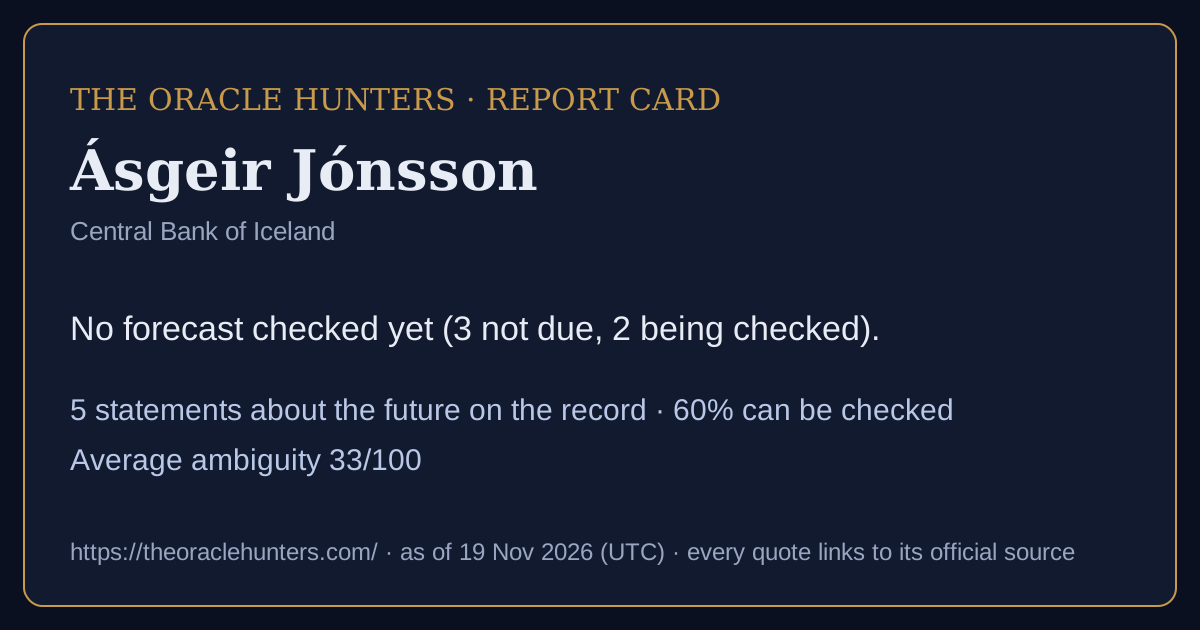
Track record: No forecast checked yet (3 not due, 2 being checked).
5forecasts & commitments on the record
60%can be checked as stated
33average ambiguity (0-100)
0goalpost moves recorded
0confirmed U-turns
Timeline
came true partly did not not due / being checked / too vague
Calibration score: shown after 10 checked forecasts with a stated likelihood (now 0).
How they speak about the future: based on data 3, stated on authority 2.
Kinds of claim: mixed claim 3, commitment 1, forecast 1. · Download this report card as a picture
In the nine words
πρόγνωσιςInference from evidence3 · 60%μαντείαInspired knowledge1 · 20%προαναγγελίαPublic pre-announcement1 · 20%
How to read this
Each box is one sentence a public figure or institution said about the future, word for word, with a link to the official text. Can be checked means it names what will happen, by when, and how likely - so it can be compared with official figures later. Too vague to check means it does not. Ambiguity (0-100) is how many different ways the sentence can be read. When the date passes, the forecast is compared with official data and marked came true, partly or did not come true. Labels judge the sentence, never the person. Full guide and glossary.On the record (5)
The risk is particularly great now, not only because inflation expectations are so poorly anchored to target but also because the spring 2024 wage agreements contain a termination clause that will be triggered if twelve-month inflation exceeds 4.7% on 1 September 2026.
The outlook is also for capital requirements due to mortgages with relatively low loan-to-value ratios to decline even further with the implementation of the third Capital Requirements Regulation (CRR III) in coming months.
I am convinced that, once the dust settles after the period of rapid price rises and supply shortages in the housing market, we will see continued growth in the banks' mortgage lending, similar to that seen in neighbouring countries, and Icelandic households will then be able to borrow on the best possible terms.
In Sweden, new legislation on Sveriges Riksbank states that the bank shall call in capital from the government if its capital falls below a specified minimum, so that the bank will not end up in a persistent negative capital position, as it did in 2022.
In fact, it is stated explicitly in the contracts that they will be terminated if inflation is above 4.95% in August 2025.
Also said - not checkable as stated (12 newest)
Remarks about the future with no date, figure or likelihood that could be checked. They are kept on the record and shown here, but not scored.
Even so, the oil price shock exposes us to the risk that we will yet again start scaling the inflationary cliff when the oil price hikes start showing in the CPI.
This is one of the reasons the Bank's Monetary Policy Committee raised the policy interest rate at its last meeting and, all else being equal, will have to raise it further.
The main reason for this is that we have not managed to do what Bjarni Bragi Jónsson recommended in 1982 - to put in place an effective social covenant consistent with the 2½% inflation target - so that we as a nation could allocate the available resources among ourselves without creating inflation.
According to figures from Eurostat, wages in Iceland are the highest in Europe and may be the highest in the world.
The above-described problems in the Icelandic labour market will not be solved automatically.
As long as private sector balance sheets remain strong and resilience is sufficient, it is quite likely that the economy will achieve a soft landing after a period of very buoyant GDP growth.
The Bank's current assessment is that the reserves should not be below 120% of that metric.
As a result, and as a step in that direction, the Bank will initiate a new programme of regular foreign currency purchases in the domestic interbank market on 15 April 2025, the 171st anniversary of free trade in Iceland.
The programme will be explained in more detail in a press release posted on the Bank's website.
The new contracts should ensure that a wage-price spiral will not develop.
We will get results, but only if we are steadfast and disciplined and if all of us abide by the groundrules of the policy structure we have chosen.
It cannot order that prices shall be different than the principles of price formation dictate.